Reflections
They Served the Country. Now They Can Help Hold It Accountable.
A Veterans Day RESET reflection on service, justice, and public responsibility.

Reginald Lee Bachus
November 11, 2026 · 7 min read
To every veteran, to those serving today, and to the families who carry the weight of that service: on behalf of myself and RESET, thank you.
We honor your courage, your commitment, and the portions of your lives given to this country. We remember those who gave their lives and the families who continue to live with their absence.
One of the things I love about democracy is that every two years, we get another opportunity to send people to Congress who are supposed to speak on behalf of the people affected by the decisions being made.
On this Veterans Day, that opportunity carries particular meaning.
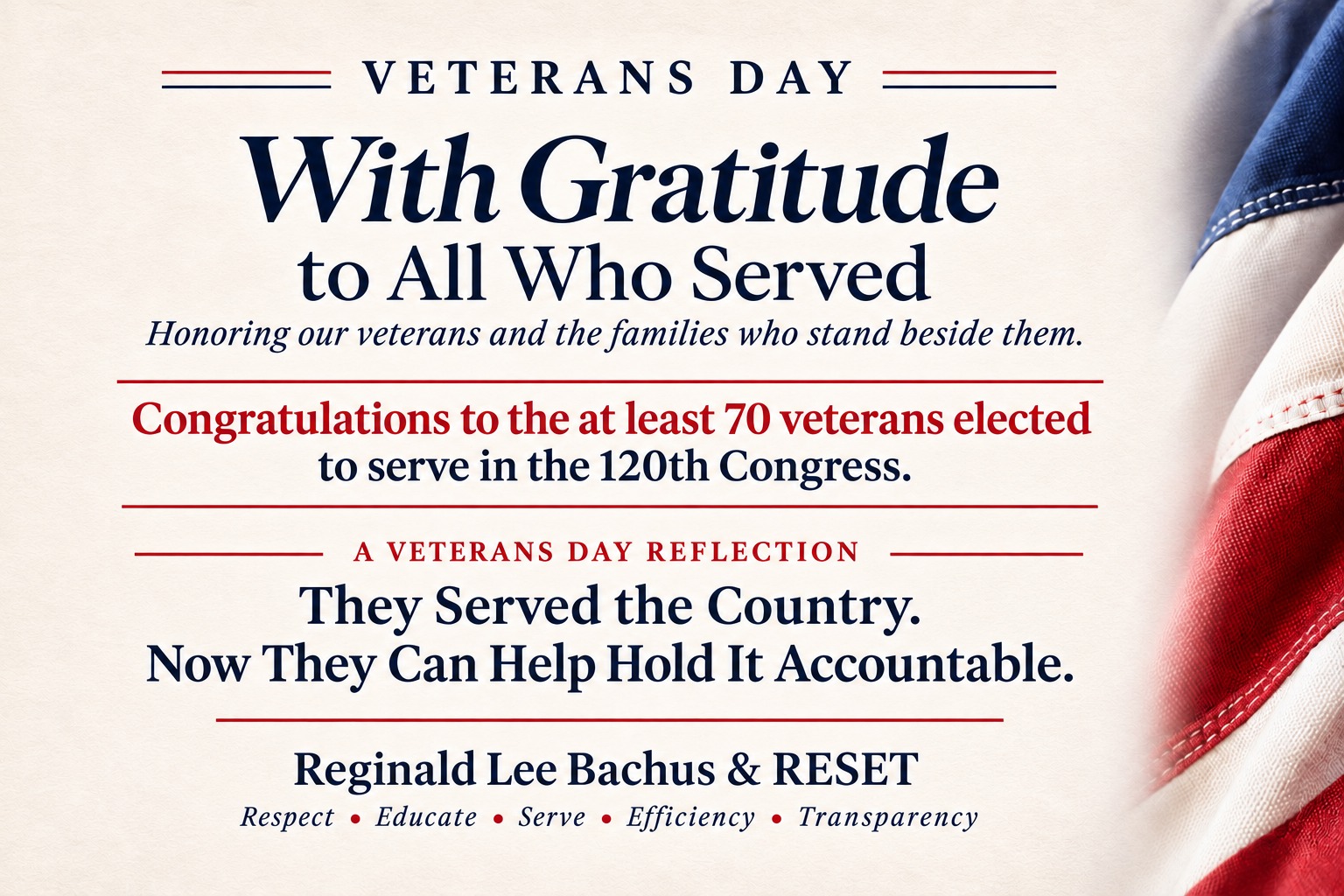
Congratulations to the at least 70 veterans elected to serve in the 120th Congress, according to preliminary November 6 figures from With Honor Action reported by Spectrum News.1, 2 They join ten veteran senators who were not up for reelection. That reporting identified at least 16 incoming freshmen and a record 12 women veterans expected to serve, with some races still unresolved.1
They served the country. Now they can help hold it accountable.
These men and women bring different political convictions, military experiences, communities, and perspectives. Their presence brings firsthand knowledge into decisions affecting veterans and the rest of our country.
I approach that service with respect.
I write, I speak, I preach, and I offer my views about the direction of this country. As a pastor, I engage the spiritual battlefield every day. But I have not served in uniform or accepted the military obligation to place myself in harm’s way for this nation.
They made a commitment to defend this democracy that I have not made. That deserves acknowledgment, humility, and respect.
It should make me more careful about my questions, more willing to listen, and more determined to get the facts right.
1. REMEMBER THE PEOPLE BEHIND THE POLICY.
For me, this is where RESET applies:
Remembering those who served should reorient how we make decisions. Are our actions—and the results they produce—in alignment with the dignity of their lives and their demonstrated service?
VA estimates approximately 17 million veterans in fiscal year 2026.3 More than 6.3 million received service-connected disability compensation at the end of fiscal year 2025.4 These are different populations, and neither figure establishes how many veterans were harmed by a particular policy.
Behind those numbers are households balancing rent, groceries, medical needs, and raising children. There are caregivers arranging their lives around appointments. There are veterans whose civilian jobs provide income and a continued sense of purpose.
Respect requires us to see those lives. Educate requires us to understand their circumstances. Serve requires us to ask: Who does this decision serve?
An executive, political official, or agency leader approving a reduction may be far removed from the household absorbing its consequences. Their family may never experience the missed paycheck, interrupted service, or longer wait created by that decision.
That distance makes awareness essential. Those carrying the consequences need a voice before decisions are made and a way to be heard afterward.
2. EFFICIENCY MUST BE DEMONSTRATED.
In July 2025, VA announced that it expected nearly 30,000 staff departures by the fiscal year’s end through attrition, retirements, deferred resignations, and the hiring freeze. The department said this would avoid a contemplated large-scale reduction in force and that safeguards would protect care and benefits.5
That target was not a count of people fired. A smaller workforce, however, does not by itself demonstrate better service.
What was the operational plan? Which positions could be lost while protecting care? Were vacancies, specialized skills, facility needs, and experienced employees’ knowledge considered?
What measures would reveal whether the change was working? What would trigger a correction?
Congress should obtain the supporting plan and assess it. We should neither assume no plan existed nor accept an assurance as proof that it worked.
Has the outcome been demonstrated? Has it been independently checked? What do appointment availability, claims processing, employee workload, and veterans’ experiences show?
Transparency makes the promise of efficiency testable.
Efficiency must account for the work completed, the quality of service, and the costs carried by families.
Accuracy matters, too. Department of Labor guidance continues to recognize protected veteran status under the Vietnam Era Veterans’ Readjustment Assistance Act.6 The evidence reviewed for this reflection does not establish that this status is about to disappear.
Employment protections, federal hiring preferences, civil-service appeal rights, and VA benefits are separate matters. We must get those distinctions right.
3. GIVE CREDIT WHERE VETERANS SEE PROGRESS.
My purpose is to see veterans receive better care, timely benefits, and a fair transition home.
When veterans’ organizations welcome the administration’s actions, we should listen.
The American Legion welcomed President Trump’s September 2026 executive order directing improvements in military-record sharing, access to benefits, and employment transition support.7 Implementation and results deserve follow-up.
In April 2026, the Veterans of Foreign Wars applauded an executive order supporting research and access pathways for emerging mental health treatments, including psychedelic-assisted therapies.8 Supporting research does not establish that a treatment is proven or broadly available. Responding to veterans’ advocacy still deserves acknowledgment.
In February 2026, the VFW commended VA for rescinding a disability-rating rule after veterans and advocates warned it could unfairly reduce benefits. The organization credited Secretary Doug Collins for listening and changing course.9
That deserves a complete accounting: the concern raised by the original policy, the advocacy that challenged it, and the decision to reverse it.
RESET’s commitment to Educate requires us to keep learning when evidence complicates our preferred argument. Serve requires us to support improvements that help veterans, whoever receives the political credit.
4. FOLLOW THE STORIES THROUGH TO THEIR OUTCOMES.
Four documented 2025 cases illustrate why oversight matters.
In Western New York, Senator Chuck Schumer’s office reported that Army veteran Alissa Ellman was fired from the Buffalo VA despite meeting production expectations.10
In Kansas, KCUR reported that Navy veteran Donny Newsom lost his senior project manager position at the National Oceanic and Atmospheric Administration.11
In Colorado, Senator John Hickenlooper’s office reported that Navy veteran Amelia Huffman was terminated from the Forest Service.12
In California, Senator Adam Schiff’s office reported that disabled Army veteran Tony Ruiz was fired from his veterans service representative position shortly before his probationary period ended, despite previously receiving an employee award.13
These are attributed accounts of what was reported then, not independent judicial findings or claims that each person remains unemployed today.
What evidence supported those decisions? Who was reinstated? Who received back pay? What happened to the work they performed?
Four stories cannot establish a national total. They can identify questions that deserve a reliable accounting.
5. JUSTICE CAN ARRIVE SLOWLY. THE COST BEGINS IMMEDIATELY.
There is a particular exhaustion that comes from watching a wrong happen quickly and its correction move slowly.
A termination notice can arrive in minutes. Establishing whether it was lawful can take months or longer.
People hear that a review is underway and wonder whether anyone understands what the waiting is costing them.
Due process is essential. Evidence must be examined. Accusations must be tested. People accused of wrongdoing have rights, too. A responsible process must also recognize the urgency of relief for those experiencing harm.
The clock of accountability often runs slower than the clock of household survival.
Restoring a job may not repair every consequence of losing it. Back pay can address lost wages while leaving other damage unresolved.
A finding matters. What follows that finding matters as well.
6. TURN AUTHORITY INTO RESULTS.
Congress can pursue legislation, funding, oversight, and constituent assistance through its lawful processes.14, 15 Members-elect take up their authority when their terms begin.
Veterans in Congress have a particular opportunity to bring their experience to that work. Every member shares the responsibility.
Establish the record. Examine the justification. Measure the consequences. Preserve improvements. Pursue lawful remedies where violations are established. Report back to the people.
Respect those affected.
Educate through reliable evidence and firsthand experience.
Serve the public interest.
Demonstrate Efficiency through results and the full costs of decisions.
Practice Transparency about plans, findings, and corrections.
7. KEEP FAITH WITH THOSE WHO ANSWERED THE CALL.
Remember the people and the promise. Reorient our decisions around those who served and the families beside them. Become aware of who benefits, who bears the burden, and whose experience has been left out. Then choose and move with intention.
That is RESET in practice.
To our veterans, those serving now, and your families: thank you. May God bless you. May your country honor you through the care it provides, the rights it upholds, and the promises it keeps.
And to those moving from military service into congressional service: ask hard questions, protect rights, advance what works, and help this country keep faith with its people.
You answered the call to serve. Now help ensure that those who govern answer the call to accountability.
- Veterans Day
- Veterans
- Democracy
- Accountability
- RESET
Sources and Notes
- 1.Spectrum News 1, “At least 80 military veterans set to serve in Congress,” November 6, 2026 (figures from With Honor Action) (opens in a new tab)
Supports the dated, preliminary count as of the morning of November 6: at least 70 veterans elected, joining ten veteran senators who were not up for reelection, with at least 16 incoming freshmen and a record 12 women veterans expected to serve. Some races were still undecided. These are not final certified totals, and 70 is not the total veteran membership of Congress.
↩ Back to text for source 1 - 2.With Honor, “With Honor Congratulates Veterans Elected to Congress, Including a Record Number of Women Veterans” (opens in a new tab)
An earlier preliminary election count from the organization behind the figures. Totals may change as races are resolved and certified.
↩ Back to text for source 2 - 3.U.S. Department of Veterans Affairs, “Memorial Day 2026 – Honoring Service: 250 Years of Sacrifice and the Veterans We Serve” (opens in a new tab)
VA’s estimate of the veteran population in fiscal year 2026.
↩ Back to text for source 3 - 4.U.S. Department of Veterans Affairs, Veterans Benefits Administration, Annual Benefits Report, Fiscal Year 2025 (PDF) (opens in a new tab)
Service-connected disability compensation recipients at the end of fiscal year 2025. This is a different population from the total veteran estimate.
↩ Back to text for source 4 - 5.VA News, “VA to reduce staff by nearly 30K by end of FY2025,” July 2025 (opens in a new tab)
A dated projection of expected departures through attrition, retirements, deferred resignations and the hiring freeze, not a count of firings or a verified current staffing result. The statements about avoiding a large-scale reduction in force and safeguarding care and benefits are VA’s own.
↩ Back to text for source 5 - 6.U.S. Department of Labor, Office of Federal Contract Compliance Programs, “Vietnam Era Veterans’ Readjustment Assistance Act Regulations Frequently Asked Questions” (opens in a new tab)
Current guidance recognizing protected veteran status. It does not indicate that the status has been abolished.
↩ Back to text for source 6 - 7.The American Legion, “American Legion supports Executive Order benefitting veterans,” September 2026 (opens in a new tab)
The Legion’s response to the September 2026 executive order. Implementation and results are separate questions.
↩ Back to text for source 7 - 8.Veterans of Foreign Wars, “VFW Commends White House Executive Order Advancing Research, Access to Emerging Treatments,” April 2026 (opens in a new tab)
Support for research and access pathways. Supporting research does not establish that a treatment is safe, effective, or broadly available.
↩ Back to text for source 8 - 9.Veterans of Foreign Wars, “VFW Commends VA for Listening to Veterans’ Voices and Rescinding Rule,” February 2026 (opens in a new tab)
The VFW’s response to VA’s rescission of the disability-rating rule.
↩ Back to text for source 9 - 10.Office of Senator Chuck Schumer, press release on Alissa Ellman, 2025 (opens in a new tab)
An account reported by a congressional office in 2025. It is not a judicial finding, and no claim is made about current employment status.
↩ Back to text for source 10 - 11.KCUR, “Fired federal workers in Kansas City call on Congress to ‘make some sense’ of DOGE chaos,” March 11, 2025 (opens in a new tab)
News reporting from 2025 on Donny Newsom. No claim is made about current employment status.
↩ Back to text for source 11 - 12.Office of Senator John Hickenlooper, press release on Amelia Huffman, 2025 (opens in a new tab)
An account reported by a congressional office in 2025. It is not a judicial finding, and no claim is made about current employment status.
↩ Back to text for source 12 - 13.Office of Senator Adam Schiff, press release on Tony Ruiz, 2025 (opens in a new tab)
An account reported by a congressional office in 2025. It is not a judicial finding, and no claim is made about current employment status.
↩ Back to text for source 13 - 14.U.S. House of Representatives, “The House Explained” (opens in a new tab)
Congressional membership and committee responsibilities.
↩ Back to text for source 14 - 15.The White House, “The Legislative Branch” (opens in a new tab)
The powers of the legislative branch.
↩ Back to text for source 15