RESET
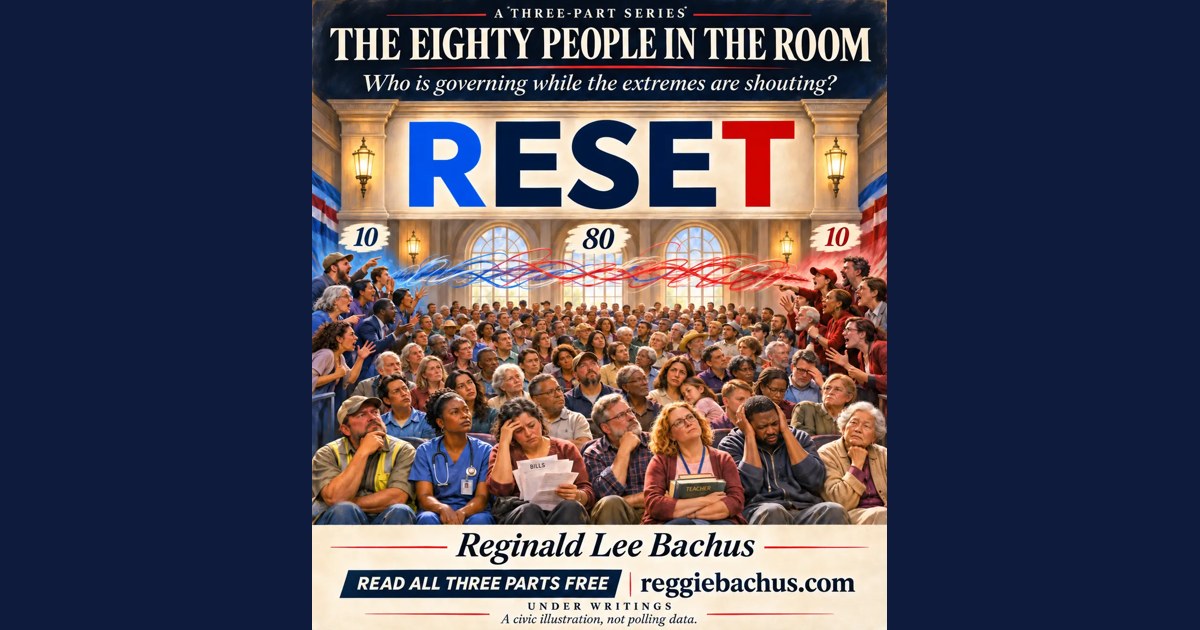
The Eighty People in the Room, Part Three: America Needs a RESET
Why I developed RESET—and how Respect, Educate, Serve, Efficiency, and Transparency can guide our choices and strengthen public accountability.

Reginald Lee Bachus
November 5, 2026 · 8 min read
1. The people have acted. Their government must respond.
When people organize, persuade, cast ballots, and remain engaged, they participate in a constitutional process.
They also make an act of trust.
They deserve serious work, clear explanations, measurable progress, and accountability from those elected through that process.
No official can guarantee every desired outcome. But what happens when people repeatedly fulfill their democratic responsibilities and conclude that officials will not fulfill theirs?
Trust erodes. People withdraw. Cynicism hardens.
Claims that democracy cannot work begin to sound plausible to people who once defended it.
I think about the new voter—and the returning voter—who said, “I’ll give this one more chance.”
What response do we have for that person? What evidence can we offer that participation will produce something beyond another round of political theater?
We must remain peacefully engaged. Those entrusted with power must demonstrate that engagement matters.
2. RESET grew out of the drift I was witnessing.
I am a moderate informed by my love of God, love of country, and Black experience. I am a practicing student of history and a pastor who studies people, trends, and culture.
Donald Trump’s election gave me serious pause about where the country was headed and the signal his election sent to the world.
From the beginning, I saw an approach to power that deepened my concerns: personal loyalty elevated over public responsibility, constitutional limits treated as obstacles, and political conflict turned into a constant public spectacle.
In my judgment, a Republican-led Congress too often accommodated that behavior rather than exercising independent oversight.
What disturbed me was the willingness to excuse conduct that should have troubled people regardless of party—and the growing expectation that the public should simply absorb the consequences.
I saw a country drifting while losing the shared language needed to describe what was happening.
Through prayer, meditation, and reflection, RESET—the word and the image—became part of my mission.
I wanted to challenge how we were thinking and making decisions. Telling people they were wrong would not be enough. We needed a way to examine how we had arrived at our conclusions, what was influencing us, and whether our choices were taking us where we actually wanted to go.
I prayed for a way to help people think for themselves, speak for themselves, and become the authors of their next decisions rather than the products of their last experiences.
That is the conviction beneath RESET.
3. A moment of participation should become a lasting capacity.
My hope is that the willingness to act together does not appear only when we believe the country faces an existential crisis.
What if we developed that capacity as an ordinary part of citizenship?
What if our common interests spoke louder than the petty preoccupations and distractions consuming so much public attention?
The eighty people in the room are an illustration, not a polling category. They do not all think alike. They represent the people I meet who want to live, work, care for their families, and have a meaningful say in their future.
I still believe this country is fertile ground for a future forged together.
Dr. King’s dream cannot remain a beautiful speech we celebrate while postponing its fulfillment.
That dream has to wake up one day.
It has to live and breathe among us—in our institutions, our opportunities, and our treatment of one another.
The founding promise of equality and unalienable rights—life, liberty, and the pursuit of happiness—must become something people can experience.
That conviction needs a practical expression. It needs a way to help us recognize when our conduct has departed from our commitments.
4. Recover your grounding before choosing your direction.
In 2 Kings 22, Josiah heard the Law and tore his clothes in grief. Hearing the standard exposed the distance between the people’s commitments and their conduct.
In Nehemiah 8, the Law was read and explained so the people could understand it.
Those accounts inform how I understand the importance of returning to a standard.
America is not ancient Israel. The Constitution is not Scripture. Americans do not have to share my faith to share the responsibilities of citizenship.
For me as a Christian, spiritual grounding comes through God’s Word and Jesus Christ. For our republic, the Constitution provides our shared civic framework.
Our history includes profound exclusions and the continuing struggle to make constitutional protections meaningful for everyone—in word, deed, and everyday reality.
That struggle requires us to know the standard, understand its development, and examine whether public power is being exercised within it.
RESET approaches that work through four disciplines:
Grounded: Understand constitutional rights, responsibilities, and limits. Know the standard against which public power should be evaluated.
Aligned: Measure conduct against that standard. Recognize departures and correct direction.
Aware: Examine what institutions and officials are actually doing. We cannot expect what we do not inspect.
Intentional: Act on our convictions. Choose leaders according to the responsibilities they will carry, what they have demonstrated, and our informed judgment about their ability to deliver.
Without grounding, it is difficult to recognize drift. Without recognizing drift, it is difficult to correct direction.
And without correcting direction, we can remain busy moving while getting further from the destination we said we wanted to reach.
5. Apply RESET to the people seeking our trust—and to ourselves.
RESPECT
Who and what needs to be acknowledged and considered?
Can this person recognize another person’s dignity while disagreeing with them?
Respect allows confrontation. But confrontation should serve a purpose we can explain.
It requires enough discipline to keep contempt from becoming our permanent way of relating to people.
We begin by learning to see people for who they are, rather than accepting everything we have been told about them.
Just as each of us has a story, everybody else has a story too.
Respect says: I will honor your humanity enough to hear you before passing judgment.
Hearing someone does not require agreement or the abandonment of conviction. It requires taking seriously the people affected by our decisions.
A leader may still have to make a difficult choice. Respect asks whether that choice considers everyone involved, reduces unnecessary harm, and broadens the benefit where possible.
Application: listen honestly, confront purposefully, and consider everyone affected.
EDUCATE
What do I know, think I know, and need to know?
Have we learned the candidate’s background, examined their record, and understood the responsibilities of the office?
We should know more than whether we enjoy their personality. We should be able to explain why we trust their judgment.
Most of us have met someone who made a wonderful first impression—until we got to know them.
The same can happen with politicians.
Records, votes, interviews, disclosures, and reliable reporting help us examine the person behind the presentation. Campaign advertisements and social media claims require scrutiny too.
Information being available does not make every claim true. We must distinguish what the evidence establishes from what we have merely heard repeated.
And we must ask questions appropriate to the responsibility.
Someone may seem like a person we would enjoy having a beer with. But if another pandemic emerged, would we trust that person’s judgment with decisions affecting our health, livelihood, family, and country?
That requires different considerations.
Application: know whom you are choosing—and what you are choosing them to do.
SERVE
Who or what does this really serve?
Whose needs guide this person’s decisions?
Public office cannot become primarily a platform for the officeholder.
Ask whose burdens are reduced, whose opportunities improve, and whose concerns receive attention.
Service also requires examining our own participation. Are we helping address a public need, or have we become more invested in winning an argument than improving an outcome?
Application: make service to people the purpose of power.
EFFICIENCY
What is the most effective use of limited resources?
Can this person organize people, resources, and knowledge to deliver results?
Time, money, public attention, and institutional capacity are limited. Leaders must decide how to use them responsibly.
The world is changing. Governing requires the ability to learn, adapt, and improve systems.
We should examine a policy according to what it accomplishes, what it costs, and the burdens it places on people.
Activity alone does not establish progress. Cutting a budget alone does not establish that a system works better.
A leader should be able to explain how the resources entrusted to them are producing meaningful results.
Application: evaluate delivery, including its costs and human consequences.
TRANSPARENCY
Is it teachable, appropriate, and transferable?
Can this person explain their decisions and withstand honest scrutiny?
Can others understand the reasoning, evaluate whether the action is appropriate, and carry useful knowledge forward without depending entirely on one personality?
Public spending should be traceable. Conflicts should be disclosed. Mistakes should be acknowledged and corrected.
In an era when I believe Trump has helped normalize hypocrisy and disregard for constitutional limits, transparency matters especially. It must apply to allies as well as opponents.
Cameras and digital records make concealment more precarious. But fear of exposure should not be our primary reason for acting honestly.
I keep returning to this question:
How much time, money, and energy could we save by doing the right thing in the first place?
Energy spent manipulating a process becomes energy spent defending it, concealing it, or repairing the consequences.
The public pays through wasted resources, delayed services, and diminished trust.
Legitimate privacy and security still require protection. Transparency makes the exercise of power sufficiently visible for meaningful accountability.
Application: operate in a way that can be explained, examined, and responsibly carried forward.
6. Govern for the whole room.
America needs a Republican Party capable of responsible constitutional governance. Donald Trump is not its entire history or inevitable future.
America needs a Democratic Party capable of turning public trust into effective government. Opposition alone does not fulfill that responsibility.
Both must consider the country their present decisions are shaping.
We have responsibilities as citizens too: remain engaged, examine evidence, resist manipulation, and hold people accountable even when they belong to our preferred party.
Greed, division, and a culture that treats human beings primarily as consumers, transactions, or sources of profit can pull institutions away from their purpose.
RESET asks us to recover that purpose.
Respect shapes how we treat people. Education strengthens our judgment. Service directs our authority. Efficiency improves our delivery. Transparency makes us answerable for the result.
As the Lord gives me guidance and strength, I intend to keep working for a country capable of living more faithfully within its constitutional commitments.
This chapter is not our total story.
We can recognize preparation, build agreement, protect principles, and hold one another accountable.
We can remember our commitments, recognize our drift, and choose our direction with greater intention.
The ten on the left have a right to speak. The ten on the right have a right to speak.
The other eighty have a right to be heard—and all one hundred deserve a government that works.
#RESET #TheEightyPeopleInTheRoom